
.png)
Any ad product in this industry can tell you how many impressions you bought. Most can tell you how many clicks you got. A few can even tell you how many sales closed. But almost none of them can tell you the part that actually matters: why those sales happened, what those buyers were researching beforehand, and what they're going to buy next.
That gap is crucial: it represents the difference between renting attention and understanding a market. The latter is what enables you to drive measurable growth and run profitable performance marketing campaigns.
We've spent years building the data infrastructure under the largest and best-performing programmatic ad network in the firearms industry. ArmanetID sits at the center of it. It's the intelligence layer that powers our targeting, measurement, attribution, Dynamic Shopping Ads, Armaview, and whatever we build next. Billions of industry signals in, actionable intelligence (measurable performance) out.
What ArmanetID Actually Is
ArmanetID is a privacy-conscious anonymous behavioral intelligence framework built for the firearms and outdoor industry. It's built in-house, by our engineers, who are all explicitly pro-2nd Amendment.
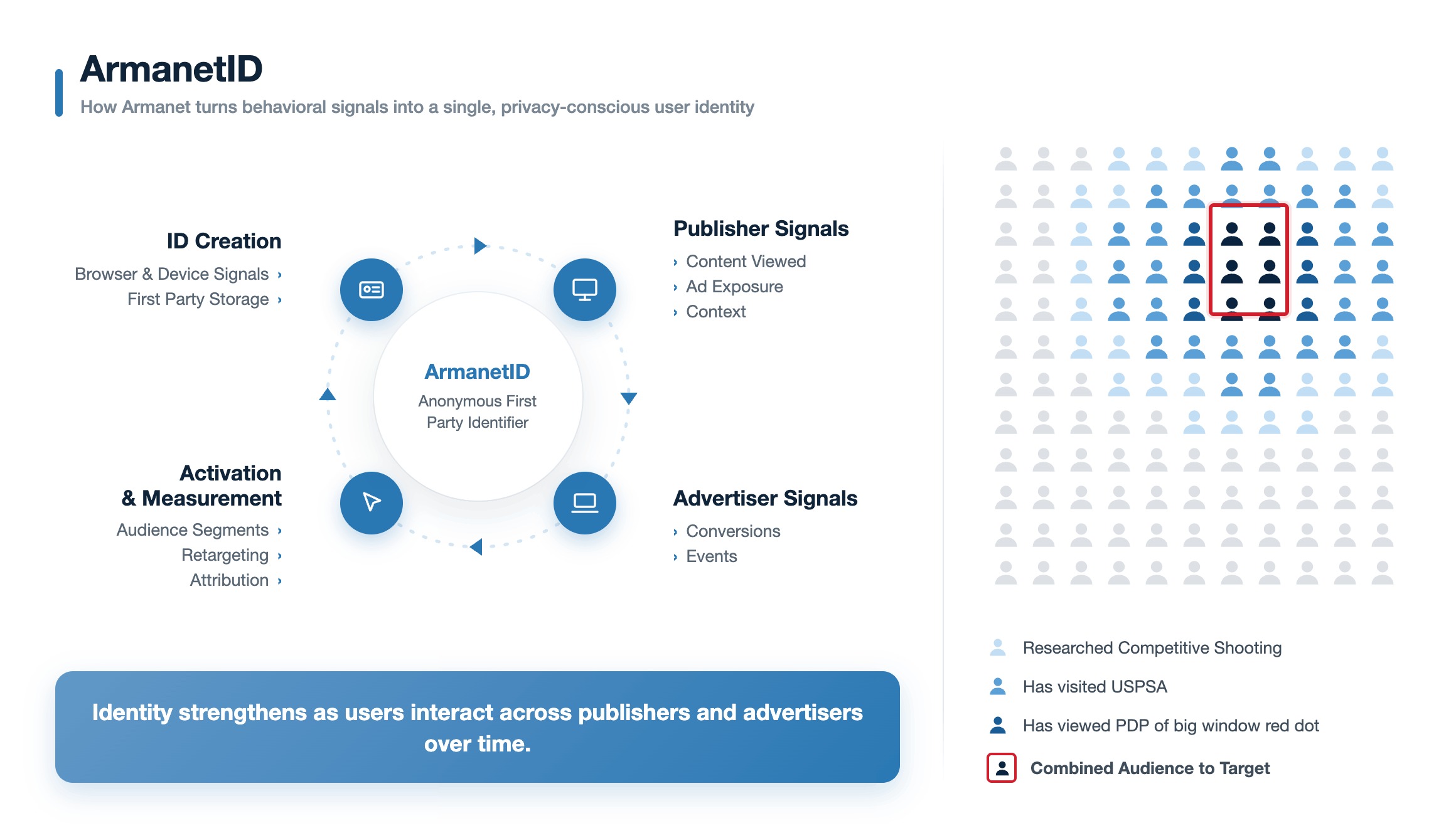
As shoppers move across Armanet (reading reviews, comparing products, engaging with content, adding to cart, buying) the platform ties those behavioral signals to an anonymous first-party identifier. The goal is to categorize ArmanetID's in a way that our advertisers are able to reach them across our network with ads that are relevant to them. Browsing behavior, research behavior, purchase behavior are all signals. Every bit of that sharpens the picture of real buying intent over time. We consciously do it in a way that doesn't involve us ever knowing who the person behind that ArmanetID is.
Why Our Data Is Different
Most audience targeting runs on one of two things: what people say about themselves on a survey, or broad, sloppy internet behavior scraped from everywhere. Neither one looks anything like how somebody actually shops for a rifle, an optic, or a plate carrier. There is no audience targeting available from Google or Meta that allows you to target people specifically in the market for the 2A product you sell. They will sell you broad lookalike audiences, but broad lookalikes don't perform as well as audiences that are probably in the market for a product. Example: Armanet knows that ArmanetID 1234 bought a carbine. ArmanetID 1234 is deterministically a carbine buyer. Targeting based on this deterministic signal will result in more performant campaigns for optics companies, since optics companies are looking to target buyers currently in the market for an optic.
Because Armanet lives inside endemic publisher inventory, the signal feeding ArmanetID comes from real activity in the category: product research, content engagement, purchase behavior, category browsing.
Experienced media buyers feel the difference between fuzzy inferred guesses and real observed granular signals in their bones. Most platforms sell you a bucket: people who look like your customers, people in a category, people who share some attribute. But an attribute is not an intent. I might watch football every Sunday and never once be in the market for cleats. A lookalike audience is full of people like that: adjacent to the purchase, but never actually reaching for their wallet. ArmanetID is built on what someone has actually done in the category. Not who they resemble. What they've done. Intent you can observe beats attributes you can infer, every time.
What ArmanetID Powers
One layer, feeding everything:
- Audience Targeting: reach buyers on what they've actually done, not fuzzily scraped 3rd party signals
- Dynamic Shopping Ads: surface the products that match real intent
- Retargeting: re-engage high-intent shoppers with efficiency
- Attribution: connect ad exposure to actual business outcomes
- Armaview Incrementality: measure the sales your advertising actually caused, not the ones that were going to happen anyway
- Future: the same foundation under every future product we ship
Privacy By Design
Intelligence doesn't require personal identity.
In firearms, "data" is a loaded word, and for extremely good reason. Nobody in this market needs me to explain why a gun buyer might not love the idea of some ad platform quietly building a file with their name on it. That fear is earned, legitimate and something to be extremely wary of. People have watched exactly this happen everywhere else.
So we didn't design around that fear, we designed for it. ArmanetID does not keep a file with your customer's name on it, because it doesn't know the name, email, or address of that customer (and doesn't want them either). The whole thing operates off of an anonymous identifier by design.
This is structural, not merely a promise. The system was built so the sensitive part (personal identity) is never the input in the first place. Behavior goes in, anonymized audience intelligence comes out, and at no point does the useful part depend on us knowing who anybody is.
A fair question here: how robust is this, really? Say a well-resourced advertiser or publisher put ten smart people on the single mission of deanonymizing ArmanetID. How far would they get? Not far. ArmanetID is a unique identifier that lives on our side, derived from signals like IP and user agent. Without access to the underlying signals (and it never leaves us) there is nothing to reverse. An advertiser can of course connect the dots on their own customers: conversion reports carry order IDs, and they can match an order ID back to a record in their own CRM. But that is their first-party data, PII they already hold, and we never touch it. What they cannot do is take an ArmanetID and pull up a customer's activity on sites they don't own, or attach a name to an ArmanetID that wasn't already sitting in their own file. The identifier is a key that only opens their own door.
Don't get me wrong, this design has a cost. It's worth being blunt about the alternative. The normal version of ad tech survives by vacuuming up every identifier it can reach: names, emails, addresses, cross-site behavior, all of it pooled, matched, and resold. That model works, in the narrow sense that it prints numbers. But it violates privacy in a way we don't think is cool in the context of firearms. We built ArmanetID as the deliberate opposite of that.
Most ad tech does what it does because of real commercial reasons: matched email lists let customers upload first-party data for targeting, and cross-channel identity resolution genuinely improves measured performance. Those capabilities are worth money, and by building on anonymous identifiers we leave that money on the table. Building that version of the platform would have required trusting match providers we don't trust, and even giving anti-2A staffed data companies the mere opportunity (they're contractually forbidden to hold on to match data from clients) to build PII graphs on gunowners is something we don't want to risk. The match rate we'd gain is significant but what we'd lose is the entire reason a 2A brand can stand behind this platform in the first place. That trade was never on the table for us, which is why we'd rather ship an intelligence layer this industry can actually trust than one that prints a slightly better number.
You get to understand your customer. We never have to personally identify them. In this industry this design choice is one that we think is critical.
Why This Matters
For advertisers: digital advertising in this industry has historically amounted to: "here's some inventory at a fixed cost, let's negotiate an annual commitment based off an estimated number of impressions."
Armanet is conversely building a smart targeting system based off of anonymous identifiers that provides quantifiably better, measurable performance in order to bring profitable paid media buying to the firearms industry at large. Targeting, attribution, dynamic shopping ads, Armaview (our incrementality measurement), all of it gets sharper because it runs on the same foundational ArmanetID system. This shifts the industry from a paradigm that was fixed-buy / awareness based to flexible, configurable performance based media buying that drives measurable growth through sales.
For publishers: better intelligence means better advertiser results, and better results mean advertisers keep coming back and keep spending. Stronger demand, more measurable outcomes, a healthier market for everyone with inventory on the network.
Today ArmanetID powers targeting, Dynamic Shopping Ads, attribution, retargeting, and Armaview. Tomorrow it's the foundation for the next generation of intelligence products built for this industry specifically. Every campaign, every product view, every conversion teaches it something, and every future campaign is smarter for it.